


A grab rail for the shower that needs no drilling is held in place by a suction cup, an adhesive anchor or a clamp, and the load capacity of the three systems varies considerably. According to the manufacturers, suction cups do not protect against falls, while bonded grab rails achieve much higher values once the adhesive has cured.
The data sheet of a suction cup grab rail lists three details directly one below the other. A suction force of 700 newtons, which is around 70 kg. A maximum user weight of 105 kg. And below that, a note from the manufacturer itself. The mobile grab handles were developed to support natural movement and are expressly not suitable for bearing the full body weight (manufacturer's information, Roth). Side by side, these three lines show the real problem with drill-free fixing. The advertised number of kilograms does not answer the question that matters in the bathroom, namely whether the grab rail will hold at the moment you slip. That is exactly what this article is about, sorted by fixing method rather than grab rail shape, with the manufacturers' figures and the limits they name themselves.
Shower grab rails without drilling at a glance
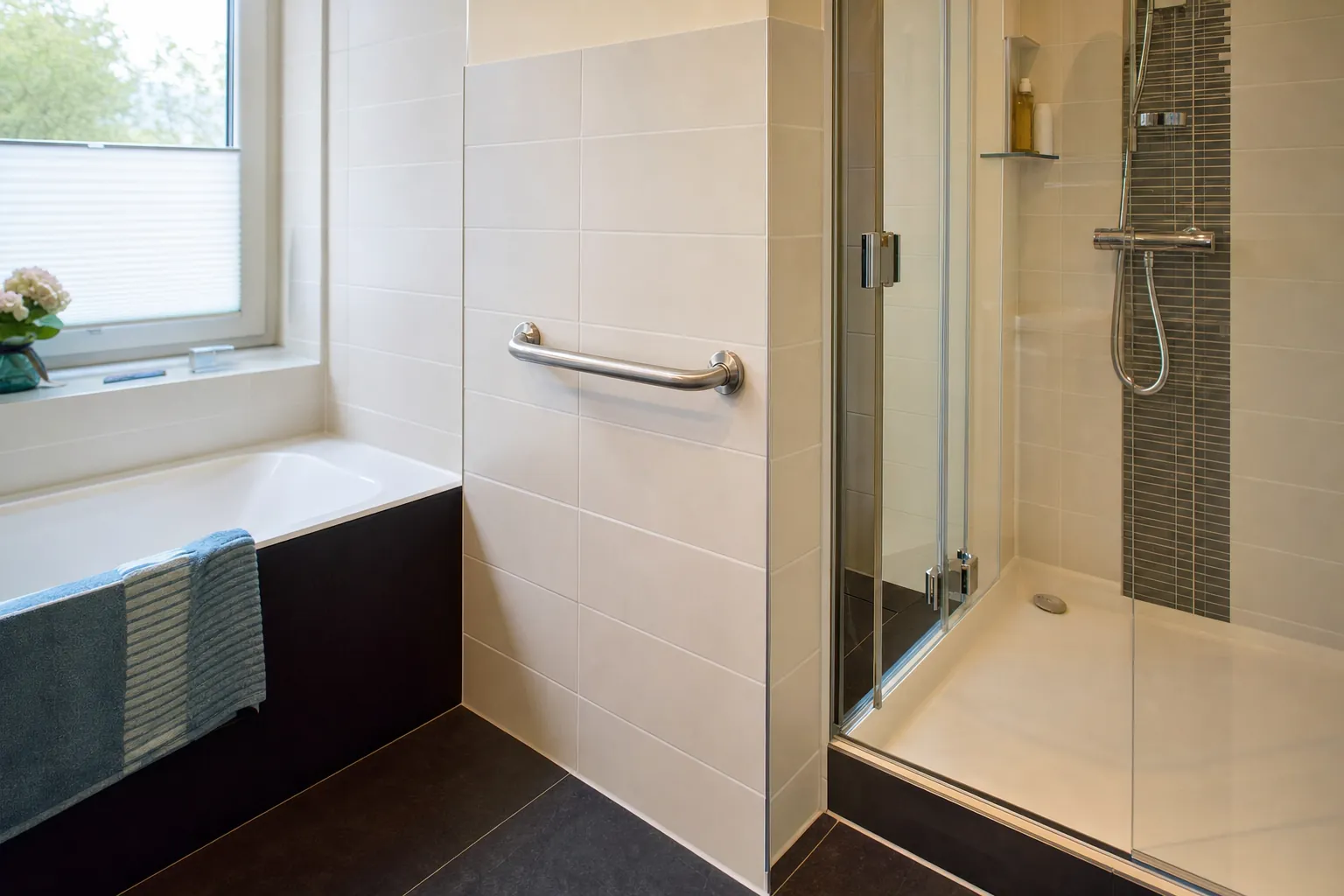
Drill-free does not mean the same thing for all grab rails. Three systems are relevant in practice, and they are technically very different.
The suction cup grab rail adheres to a smooth, airtight surface by means of a vacuum. It can be attached, repositioned and removed without residue in seconds. This very flexibility is also its weakness, because adhesion depends on the substrate, the cleanliness of the surface and the condition of the sealing lip, and it weakens over time.
The adhesive anchor is the opposite. Here, a mounting plate is permanently fixed to the tile with a two-component adhesive, and the grab rail is screwed or clipped onto it. Once cured, the connection is firm, but it can no longer be removed without leaving residue. It replaces the drill hole, not the permanence.
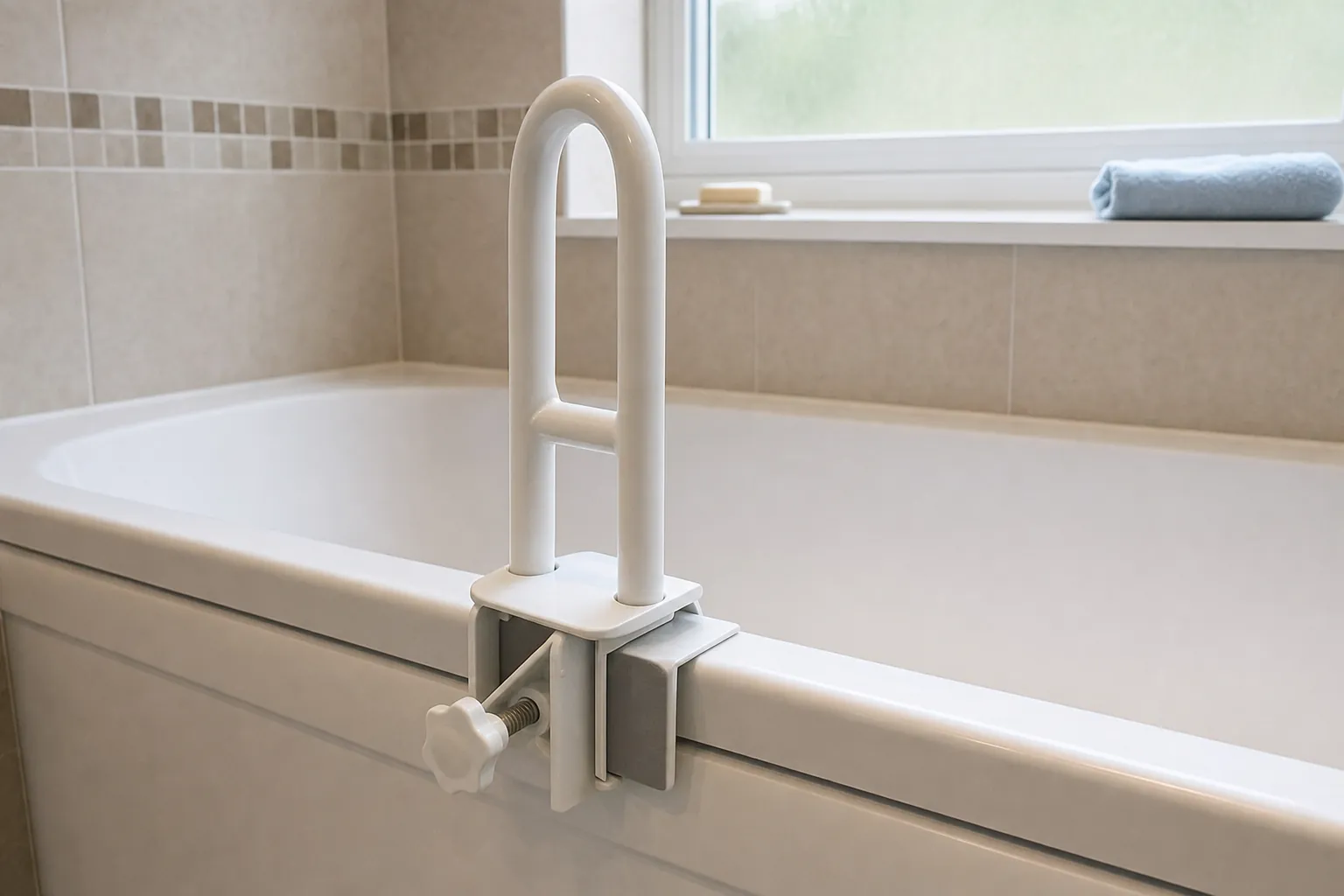
The clamping system works neither with a vacuum nor with adhesive, but with mechanical tension. The classic case is the grab rail clamped over the edge of the bathtub. It does not need a suitable wall covering, but a suitable bath edge.
| Fixing method | Load capacity according to manufacturer | Substrate | Removal |
|---|---|---|---|
| Suction cup | Suction force 700 N, equivalent to around 70 kg, maximum user weight 105 kg (Roth); up to 33 kg per adapter for bathroom accessories (Wenko) | flat, non-porous surface, tiles larger than 130 by 130 mm | leaves no residue |
| Adhesive anchor | 100 kg (Ridder, Delficare), up to 130 kg depending on the model (Roth) | tiles, natural stone, concrete, glass, metal, clean and load-bearing | leaves residue |
| Clamp on the bath edge | 120 kg (REHASTAGE) | bath edge from 2.9 to 13.5 cm thick | leaves no residue |
All values in this table are manufacturers' figures for individual models and not general properties of the respective type. They apply under the conditions stated by the respective manufacturer in its instructions.
Suction cup grab rails and their actual load capacity
The advertised load capacities for suction cup grab rails vary by a factor of three. A suction adapter for bathroom accessories from the manufacturer Wenko is rated at up to 33 kg per adapter, a suction pad grab rail from Roth at 700 newtons of suction force on flat, non-porous surfaces. The care portal pflege.de quotes a general pull force of 70 to 100 kilograms for suction grab rails. There is therefore no uniform test standard, which is why a figure on the packaging tells you little.
More important than the figure is what the manufacturers write about the intended use. Roth puts it unmistakably for its own suction pad grab rail and rules out bearing the full body weight. A suction cup grab rail is therefore a support aid for controlled movement, not a point to catch you in a fall. Both feel similar in the hand, but in terms of safety they are completely different things.
Then there is the question of the substrate, which is where a suction pad often fails in practice. The suction pad needs a continuous, flat and airtight surface. Roth specifies tiles larger than 130 by 130 millimetres for its model, because every joint under the sealing lip is a path for air. With small-format tiles, mosaic or textured surfaces, suction fixing is therefore generally ruled out. Even fine residues of care products impair adhesion.
Accordingly, the Swiss Council for Accident Prevention BFU considers suction cup grab rails suitable only for short-term use, such as when travelling, and requires careful fitting according to the instructions and regular checks. If you nevertheless use one permanently, you should check the suction before every use. Some models have a colour indicator for this that shows when the vacuum is weakening.
Bonding a grab rail instead of drilling
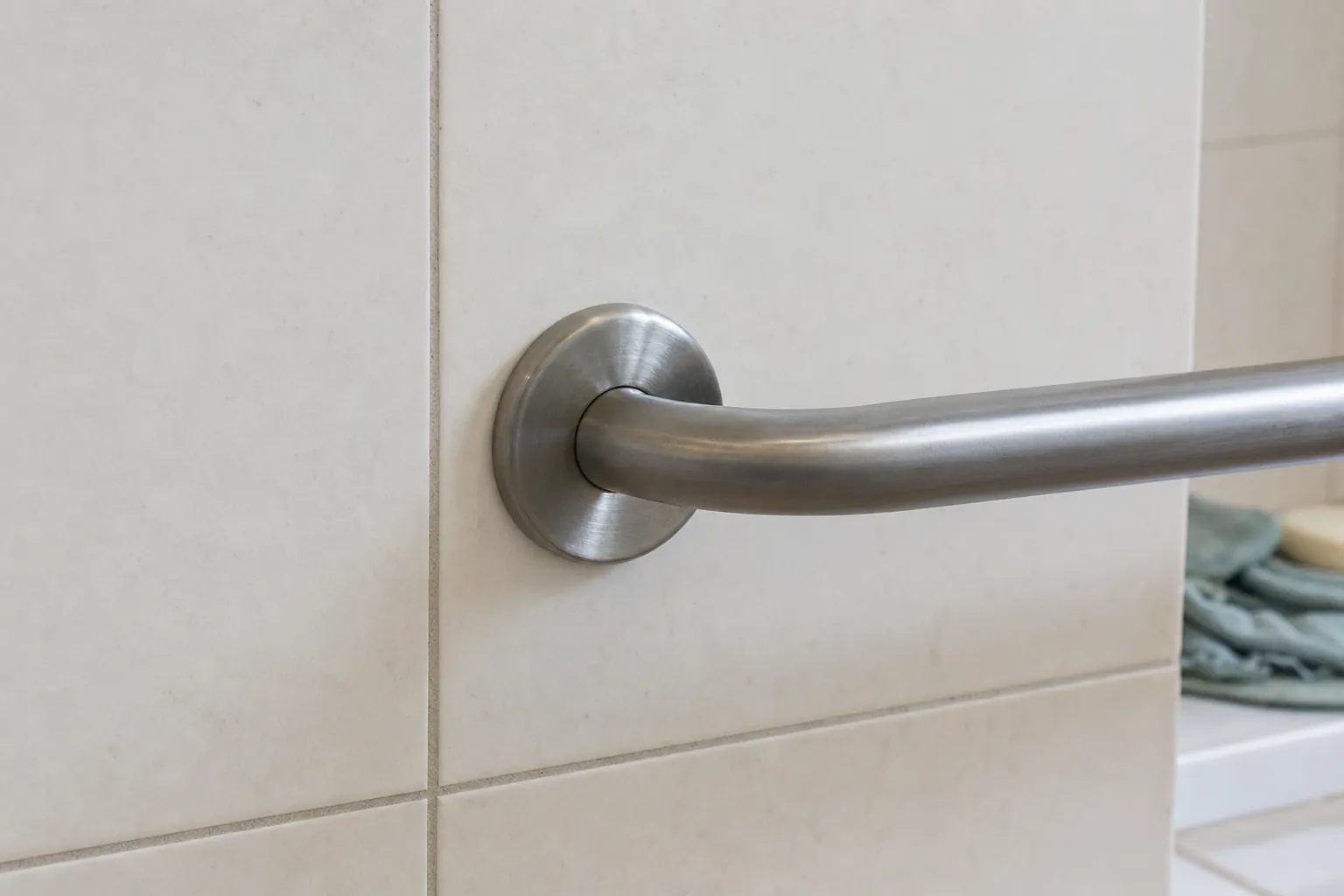
Of the drill-free options for the wall, the adhesive anchor comes closest to a fixed installation in terms of load capacity. Ridder states a maximum holding force of 100 kg for its mounting adhesive, and Delficare likewise a pull force of 100 kg for the Varioplus grab rail. Roth quotes up to 130 kg user weight for its bonded Glubeli range, and 110 kg for some models. All of them require a clean, level and load-bearing substrate. Ridder names tiles, natural stone, concrete, glass and metal as suitable materials.
The decisive factor is time, which is often underestimated when bonding. The Ridder adhesive can take its full load after 24 hours, and before that the grab rail must not bear any load. A shortened curing time does not produce a half-firm connection, but an unreliable one.
The following procedure has proved effective for fitting:
- Choose an area that is completely flat and has no joint in the bonding area
- Remove old silicone residue, limescale and any film from care products without leaving residue, then rinse with clear water and allow to dry
- Mark the position with the grab rail dry before any adhesive is used
- Apply the adhesive according to the manufacturer's instructions and press the plate on evenly
- Wait for the full curing time, 24 hours in the case of the Ridder adhesive
- Only then apply load carefully, and check the fit again after a few days
To be honest, there are two limitations. The adhesive anchor cannot be removed without leaving residue, and the tile will usually show a visible mark afterwards. And the grab rail is only as firm as the tile itself. A hollow or loose tile does not become more load-bearing because of the adhesive; if in doubt, it will come away from the wall together with the grab rail.
Clamp-on grab rails for bath and shower wall
On the bathtub, there is a drill-free solution that works differently from a technical point of view and is therefore often the better one. The clamp-on grab rail grips over the edge of the bath and is tensioned mechanically. One model from REHASTAGE is rated at a maximum load of 120 kg with an adjustable clamping width of 2.9 to 13.5 cm. This range is the real selection criterion, because it decides whether the grab rail fits your existing bath. Measure the thickness of the edge before you order.
The advantage is obvious. The force is transferred into a component that is designed to take loads anyway, instead of into a bonded or suctioned surface. However, the grab rail sits on the edge of the bath and therefore only at this height, not further up in the movement.
In the shower cabin, the situation is more difficult. Glass walls and plastic elements are smooth substrates, but they are not themselves designed to take loads from the side. A grab rail on the shower screen supports the movement at best; it cannot hold your full weight. If you need lasting safety here, there is no way around the solid wall. If a conversion is due anyway, it is worth looking at 90x90 shower cabins, because the question of how to fix the grab rail then arises differently from the start.
The limits of drill-free fixing
There is no standard that explicitly prohibits drill-free grab rails. However, the requirements they have to meet follow from what the regulations and accident prevention assume.
German standard DIN 18040-2 sets a requirement for the walls of sanitary rooms. They must be built so that vertical and horizontal support rails or grab rails can be retrofitted next to the WC, shower and bathtub when needed. The standard therefore treats grab rails from the outset as wall-mounted components with a load-bearing fixing. For folding support rails at the WC, it specifies a point load of 1 kN at the front end of the rail, which corresponds to around 100 kg. This value belongs to the WC section and is not a blanket requirement for every grab rail. But it shows the order of magnitude for a grab rail that is meant to give support in an emergency. Other regulations set even higher values, with 1.5 kN according to VDI 6008-2 and 1.7 kN according to ISO 21542.
Then there is the assessment from accident prevention. The BFU states simply that only firmly installed grab rails are good grab rails, and points out that different wall materials require different fixing methods. What matters, it says, is the permissible load of the grab rail and its fixing together. It is precisely this second half where drill-free systems fail, because their fixing is the weaker part.
In practice, this means that as long as it is about extra stability for someone who stands securely and only wants to steady themselves, a bonded or clamped grab rail is a sensible retrofit. As soon as someone shifts their weight onto the grab rail, pulls themselves up on it or depends on it in case of dizziness, the grab rail should be screwed in place.
In any case, a grab rail alone is only part of the answer. According to data from the Robert Koch Institute, 23.8 percent of people aged 65 and over fell at least once within twelve months, and among those aged 80 and over the figure is 33.5 percent. These figures from the GEDA 2022 survey refer to falls in general and not specifically to the bathroom. Nevertheless, they show why it makes sense to think about support on the wall together with the floor. Which slip resistance tiles in the bathroom should have is a separate question, and it can be answered independently of how the grab rail is fixed.
Costs and where to buy
Drill-free grab rails are available from DIY stores, medical supply shops and online retailers. In the Google Shopping carousel for this topic, prices on 10 August 2026 ranged from EUR 13.99 to EUR 35.99, with this range mainly covering suction cup and clamp-on models. Bonded systems with two-component adhesive cost more. There is no universally valid test winner, because the substrates in German bathrooms are too varied for that. The useful selection criteria are the thickness of your bath edge, the format of your tiles, a verifiable manufacturer's figure for the load capacity and clear fitting instructions.
Grab rails without drilling in a rented flat
The most common reason for not drilling is a tenancy. The legal situation in Germany is more nuanced than the widespread assumption that you are never allowed to drill into tiles.
Under Section 554 of the German Civil Code (BGB), tenants can ask their landlord to permit structural alterations that serve use by people with disabilities. This entitlement does not apply if the alteration is unreasonable for the landlord after weighing up the interests of both sides, and the tenant can undertake to provide an additional security deposit. Clauses in the tenancy agreement that deviate from this to the tenant's disadvantage are invalid. Adapting a home for older age is therefore not a favour you have to ask for, but in many cases an entitlement.
On drilling itself, the local court in Paderborn decided an individual case in 2024 that is instructive for practice. According to that ruling, drilling through the tiles only counts as contractual use if the tenant cannot place the hole in the joint. In the case decided, the landlord was entitled to damages because the tenant had breached an explicit agreement in the contract. A local court ruling is not binding on other courts, and in a dispute only legal advice will help. If you want to drill, it is therefore better to get consent in writing and, wherever possible, place the hole in the joint.
For the interim period until this is clarified, a clamped or bonded grab rail is a reasonable solution, as long as it remains clear what it can do. The adhesive anchor does, however, leave a mark on the tile and is therefore itself an alteration to the rented property that should be discussed.
Frequently asked questions about shower grab rails without drilling
Manufacturers' figures for bonded systems are usually between 100 and 130 kg. Ridder quotes a holding force of 100 kg for its mounting adhesive, Delficare a pull force of 100 kg, and Roth a user weight of 110 to 130 kg depending on the model. These values apply to a clean, flat and load-bearing substrate and only after full curing, which for the Ridder adhesive means after 24 hours.
The Swiss Council for Accident Prevention requires careful fitting according to the instructions and regular checks for suction cup grab rails. In practice, this means briefly checking the fit before each use, because the vacuum can weaken over a matter of hours. Some models show the condition with a colour indicator. A loss of suction is not a material defect but to be expected.
Under Section 554 of the German Civil Code (BGB), you can ask your landlord for permission to make structural alterations that improve accessibility, provided they are reasonable for the landlord. On drilling into tiles, the local court in Paderborn ruled in an individual case in 2024 that it only counts as contractual use if the hole cannot be placed in the joint. Get the consent in writing.
There is no universally valid test winner, because suitability depends on the substrate and not on the grab rail alone. Instead, check the format of your tiles, the thickness of the bath edge for clamp-on grab rails, a verifiable manufacturer's figure for the load capacity, and whether clear fitting instructions are included. These four points tell you more than any ranking.
From retrofit to permanent solution
A grab rail without drilling is a good answer to a temporary question. It helps in a rented flat until consent has been given, it helps after an operation, and it helps wherever someone needs to steady themselves rather than be caught. It is just not an answer to getting in and out becoming harder in the long term.
From the point of view of a bathroom planner who mainly supplies baths and showers for adapting bathrooms for older age, it is worth looking at the cause at this point rather than the retrofit. A bathtub with door or comfort showers with low entry make the critical moment smaller, instead of merely securing it better.
The information in this guide is as of August 2026. The load capacities stated are manufacturers' figures for individual models and only apply under the conditions stated in the respective instructions. This guide does not replace individual advice from a specialist company.
If you are unsure whether a retrofit is enough or whether a conversion makes more sense, get in touch with us. We will look at your situation and tell you honestly what is possible in your bathroom.


