


A grab bar in the shower gives you a secure hold when getting in and out and can help prevent falls on wet tiles. Depending on the design, firmly screwed models can bear up to 175 kg.
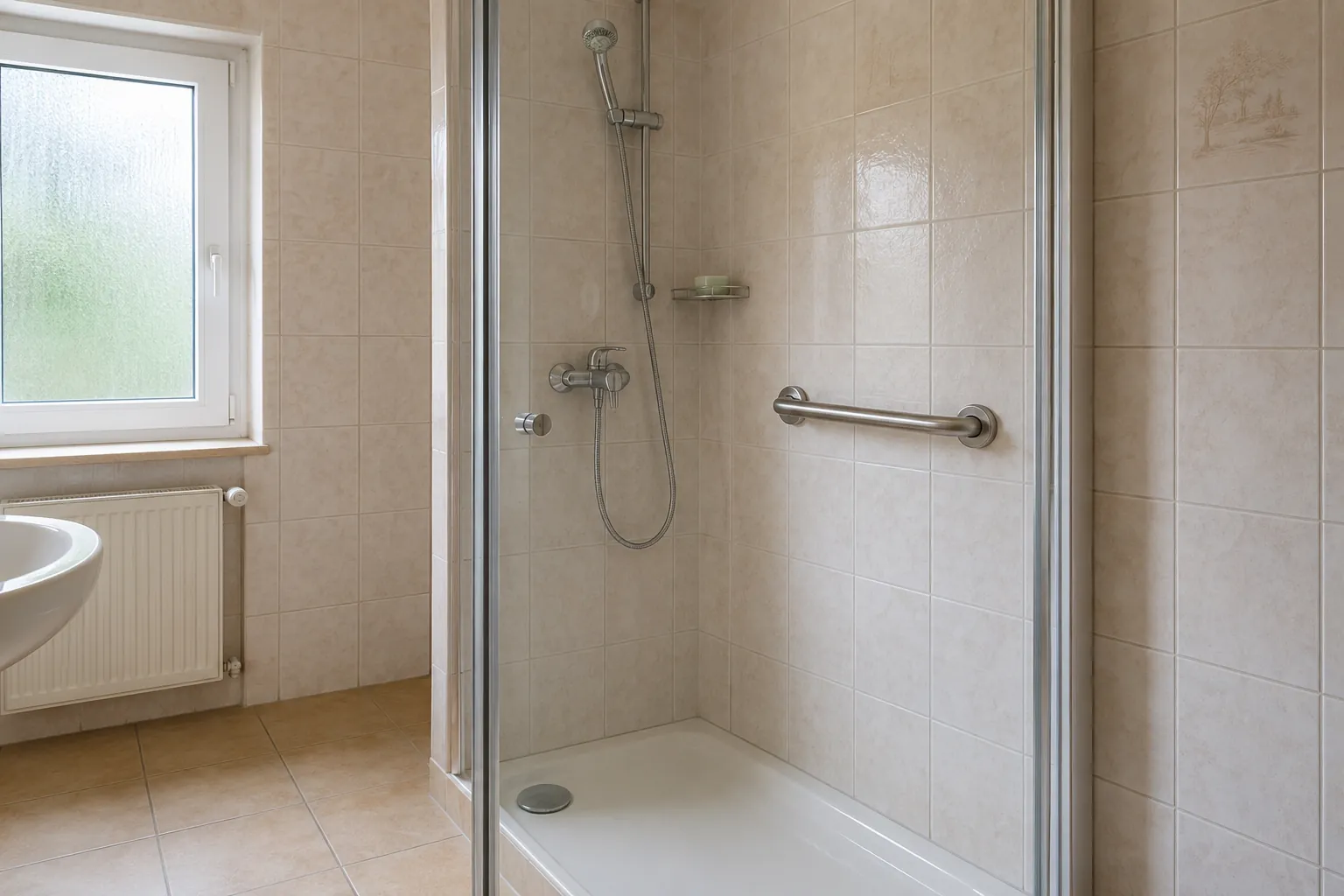
The most dangerous moment in the bathroom often lasts only a second. Your foot lifts over the edge of the shower, the tiles are wet, and for a brief moment there is no firm point of reference. This is exactly where a grab bar comes in. It gives your hand something to hold on to securely and turns a wobbly step into a controlled movement.
This guide answers the most important questions about grab bars for the shower and bathtub. You will learn which types there are, where and at what height a grab bar really gives support and how installation works. If a single grab bar is no longer enough, it is also worth taking a look at our comprehensive guide to age-friendly bathroom conversion.
Types of grab bar for the shower and bathtub at a glance
Not every grab bar suits every position. The design follows the movement. Broadly speaking, there are three designs, each intended for different movements. The straight grab bar is the classic. It is screwed to the wall horizontally, vertically or at an angle and provides support when standing, bending down and stepping into the shower. Straight models are available in many lengths, with centre distances of 30 to 100 cm being common, so there is a suitable size for every wall situation.
The angled grab bar combines a horizontal and a vertical section. It guides the hand through a whole sequence of movements, for example from getting up to standing securely, and is well suited to the transition between sitting and standing. Finally, the folding grab bar can be folded up when it is not needed. This is particularly practical next to the toilet and in narrow bathrooms, where a fixed grab bar would be in the way.
For people with limited mobility, the label "senior-friendly" or "suitable for people with disabilities" matters less than three practical features. The grab bar should have a non-slip coating or a knurled surface so that a wet hand does not slip off. It should have a diameter that is easy to grip, so that even a weakened hand can grasp it firmly. And it should be anchored firmly enough to bear your full body weight, not just a light lean.
Stainless steel has proven itself as a material, because it does not rust in a damp bathroom and is easy to clean. Grab bars with a soft, non-slip covering also feel warmer and offer a better grip than bare steel, which is particularly helpful for cold or sensitive hands. Sufficient distance between the grab bar and the wall is also important, so that your hand can reach right round and grip the bar securely. If the gap is too narrow, your fingers can slip off in an emergency, even though the grab bar itself is firmly fixed.
Positioning the grab bar in the shower correctly
A grab bar only helps where your hand can actually reach it at the crucial moment. The German standard for accessible building design serves as a guide for the height. According to DIN 18040-2, grab bars in the shower are fitted at a height of around 85 cm, measured from the standing surface to the top edge of the grab bar. This value suits a standing person of average height. If you sit while showering, for example on a folding shower seat, an additional grab bar around 28 cm above the seat helps you stand up.
There is no universal rule for the orientation, just a simple logic. A vertical grab bar helps when straightening up and taking the first step into the shower, because your hand can slide up or down it. A horizontal grab bar provides lateral support when standing and washing. Many people combine both or choose an angled grab bar that covers both directions. The key is to fit the grab bar where the movement actually takes place, in other words right at the entry and within reach of where you stand to shower.
One question comes up again and again: does a floor-level walk-in shower still need a grab bar at all? The answer is clear. The flat entry reduces the tripping edge, but the wet, often slippery floor remains, and many people find it difficult to straighten up after bending down, regardless of the threshold. A grab bar provides support at exactly these moments and is therefore also useful in a walk-in shower. Where getting in still becomes a daily obstacle, a shower cabin with a low entry or a comfort shower for safe entry can make everyday life even easier.
In practice, it has proven useful to break the route down into stages in your mind and to plan a grab bar at each critical point. These are the step over the threshold, standing securely in the shower and, if there is one, getting up from the shower seat. If these three points are covered, the movement is supported from start to finish, instead of providing safety at just one point.
Installing a grab bar in the shower step by step
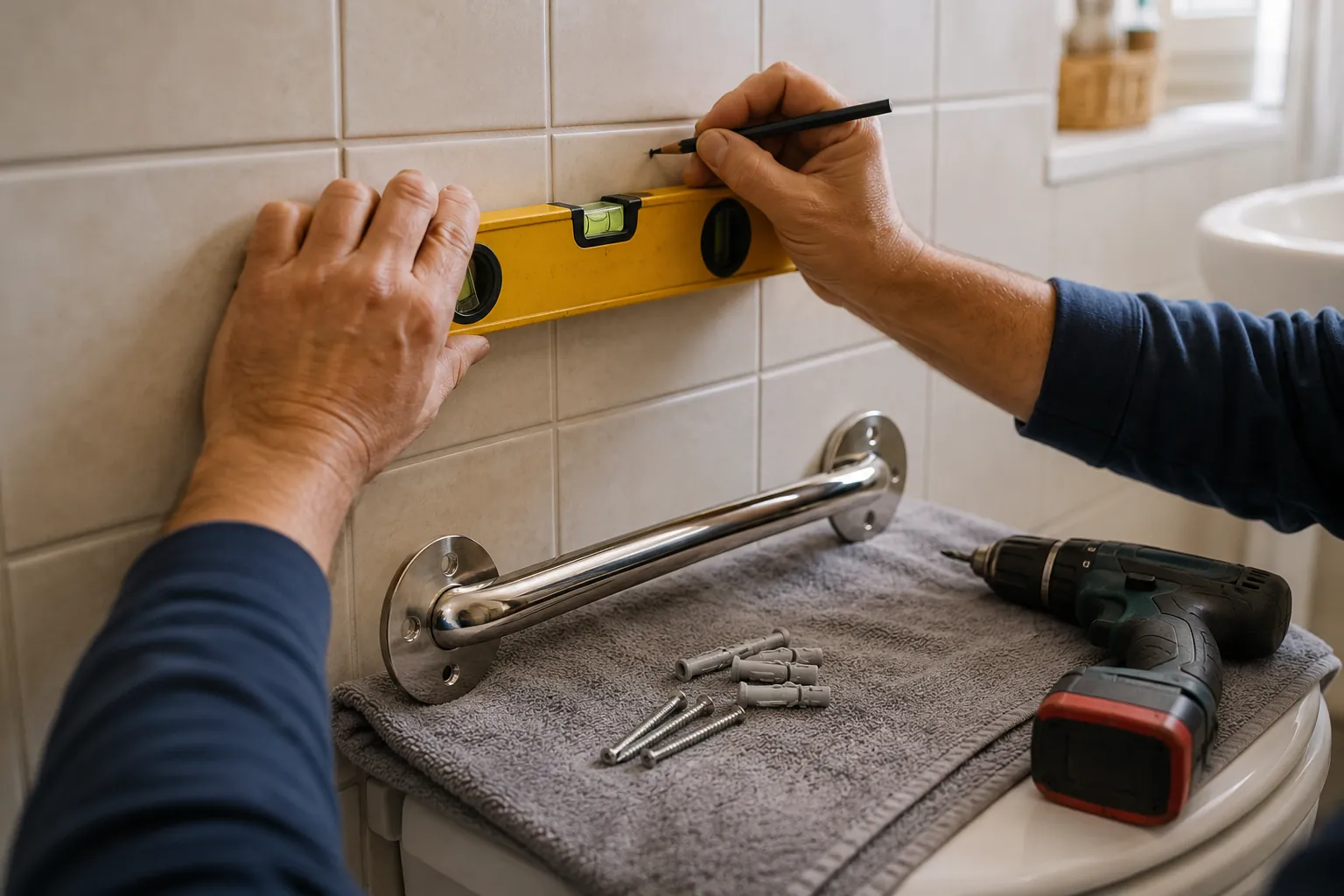
Installing a screw-fixed grab bar is a manageable DIY job, but it depends entirely on the wall. The wall is what counts. A grab bar is only as secure as the wall the plugs are fixed in. Before drilling the first hole, you therefore need to check the wall. Solid brick or concrete walls bear the load without any problem. With lightweight partition walls or pre-wall installations, the fixing must engage in the load-bearing substructure, or special cavity wall plugs are used.
This is how you usually proceed:
- Mark the position and height with a pencil and spirit level, and hold the grab bar in place once as a test
- Check the wall and choose the plugs that suit the wall type; on tiles, use a suitable drill bit
- When drilling into tiles, start without hammer action and in the middle of the tile to avoid cracks
- Drill the holes, insert the plugs, screw the grab bar in place and test it firmly with the full weight of your hand
If you are unsure about the wall or are working on a load-bearing structure, a specialist company is the right choice. For a component that has to hold your entire body weight in an emergency, professional installation is not a minor detail but the basic requirement for the support the grab bar is meant to provide.
Grab bars without drilling and their limits
Drilling is not always allowed or wanted, for example in a rented flat or as a quick solution when travelling. For these cases there are grab bars with suction cups that can be attached to smooth surfaces without tools. They are practical, but they have a clear limit that you need to know about. A suction grab bar only holds on a smooth, non-porous and clean surface, in other words on a large tile or on glass, never on grout joints, textured surfaces or porous material.
The load capacity differs considerably from that of a screw-fixed grab bar. Depending on the model, firmly screwed stainless steel grab bars can bear up to 175 kg (manufacturer's specification), and the German standard for accessible building design requires a minimum load capacity of 100 kg. For suction cup models, manufacturers state values of around 100 to 150 kg, but these figures only apply under ideal conditions and depend heavily on the surface.
| Fixing | Load capacity | Suitable as |
|---|---|---|
| Firmly screwed (stainless steel) | up to 175 kg depending on the model (manufacturer's specification) | permanent support that can bear full weight |
| Suction cup without drilling | manufacturer's specification 100 to 150 kg, highly dependent on the surface | short-term orientation aid |
A suction cup is no substitute for a screw. For people with a real risk of falling, a suction grab bar is therefore not a reliable permanent solution. It can serve as additional orientation, but it should be checked for a firm hold before every use and does not replace a screw-fixed grab bar where a secure hold is essential.
Using a grab bar at the bathtub safely
With a bathtub, the rim is the biggest obstacle. Getting in and out requires lifting your leg over a high edge while the floor is wet. A bath grab bar fitted to the rim of the bath or to the wall next to it gives you the helping hand you need at that moment. Grab bars that screw onto the bath rim are a proven solution, provided the rim is stable enough. On a tiled wall, the same rules apply as in the shower, in other words a solid wall and suitable plugs.
If drilling is out of the question, there are also models for the bathtub that clamp onto the rim without drilling. Here too, it is only fair to point out that clamped or suction grab bars are an orientation aid and not a support that can bear full weight.
If the high step-in becomes a daily strain despite the grab bar, it is worth considering a fundamentally different solution. A bathtub with door lets you get in comfortably through a side door, and a sitting bathtub for safe bathing lets you bathe entirely in a seated position. Both remove the actual danger from getting in and out, instead of merely cushioning it.
Grab bars at the toilet and other critical points
After the shower, the toilet is the second place in the bathroom where unsteady movements often occur. Sitting down and, above all, standing up takes strength and requires a stable point to support yourself. A folding grab bar next to the toilet is the common solution here, because it can be folded up out of the way and does not block access. Where space allows, two grab bars on the left and right give the best support, because the force is then distributed evenly between both arms.
It is also worth taking a close look at the washbasin and the route to it. A grab bar on the wall next to the basin helps if you need to stand for longer or your balance is declining. The principle is the same everywhere. The grab bar belongs where your hand looks for it at the moment of uncertainty, and it must be fixed so firmly that it holds your full weight in an emergency. A grab bar that is merely decorative in a convenient but useless position creates a false sense of security instead of real safety.
If your bathroom is being converted anyway
A grab bar is often the first step. If you would like to replace your shower or bathtub at the same time, you will find suitable product groups from our range here.
Senior shower bath with bath door
Bathtub and shower in one, with a door and a low door threshold.
View senior shower bathsComplete shower cabin
Cabin, shower tray and mixer in one package, with no tiles needed in the shower area.
View complete shower cabinsBathtub with door
Safe access in and out through the side door, without having to step over the bath rim.
View bathtubs with doorA secure grab bar is often the first step towards a bathroom in which you can move around without worry again. Take your time to look at the right solutions.
Frequently asked questions about grab bars in the shower and bathroom
The German standard for accessible building design serves as a guide. According to DIN 18040-2, a grab bar in the shower is fitted at a height of around 85 cm, measured from the standing surface to the top edge. If you mainly use the grab bar while seated, an additional grab bar around 28 cm above the seat makes it easier to stand up.
A suction grab bar only holds on a smooth, non-porous and clean surface such as a large tile or glass, not on grout joints or rough surfaces. Manufacturers state values of around 100 to 150 kg, but these only apply under ideal conditions. If there is a real risk of falling, a suction grab bar is therefore only an orientation aid and no substitute for a screw-fixed grab bar.
The grab bar must be fixed in a wall that can safely hold your full body weight. Solid masonry and concrete bear the load without any problem. With lightweight partition walls or pre-wall installations, the fixing must engage in the load-bearing substructure, or special cavity wall plugs are used. If in doubt, a specialist company will check the wall before installation.
Three features are more important than the label. The grab bar should have a non-slip coating so that a wet hand does not slip off, have a diameter that is easy to grip and be firmly screwed in place to bear your full weight. A straight or angled grab bar at the entry covers most movements, and a folding grab bar is suitable next to the toilet.


